
Investment Perspective / September 2026
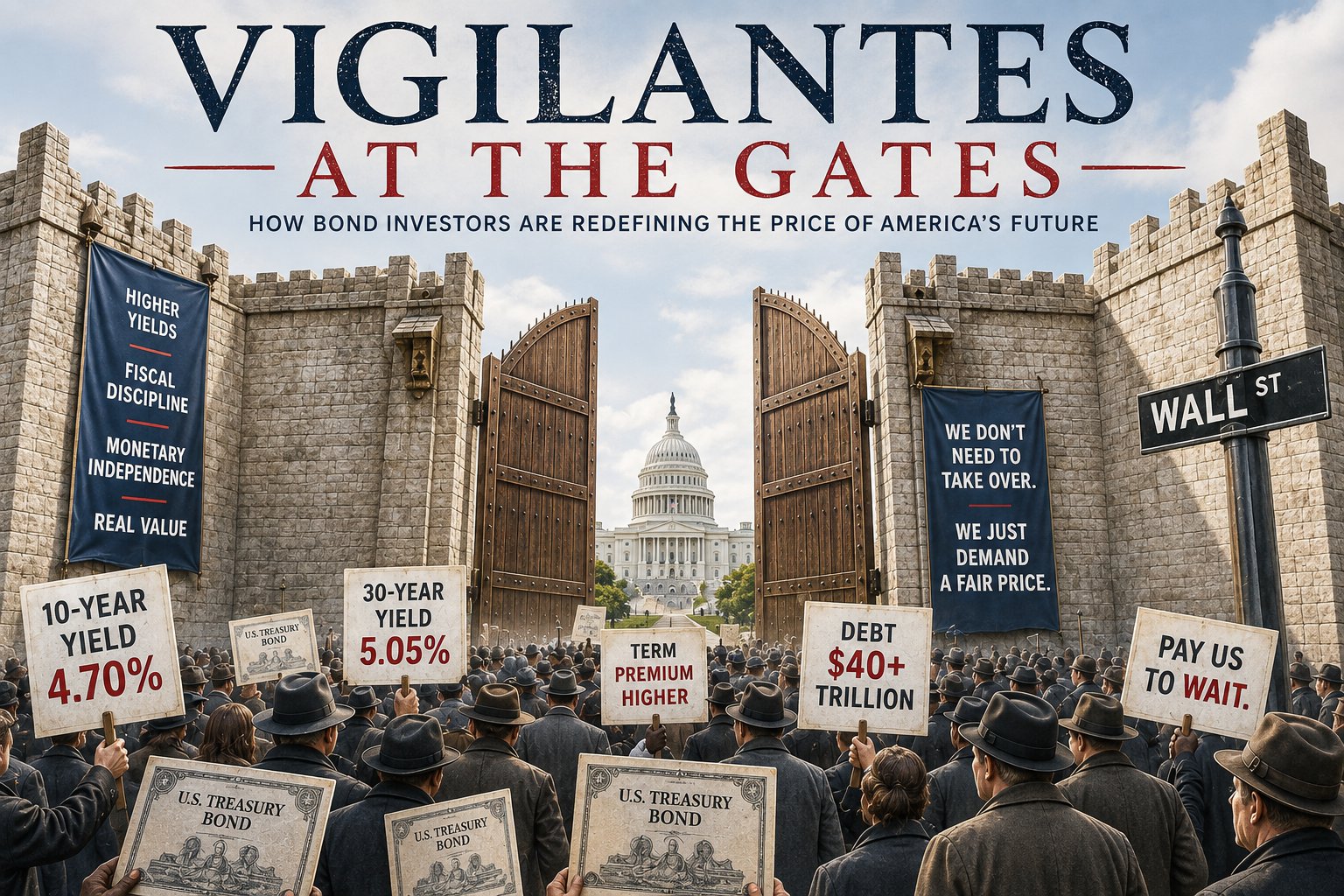
In Barbarians at the Gate, the famous account of the battle for RJR Nabisco, the threat came from outsiders trying to take control of a company. Today, the vigilantes at the gates are different.
They are the bond investors who collectively determine what it costs the United States to borrow money.
For decades, the term bond vigilantes has described investors who respond to fiscal or monetary policies they consider unsustainable by selling government bonds and demanding higher yields. They do not need to coordinate, issue demands or even agree on the diagnosis. Markets do the work for them.
And lately, they have been stirring.
Thirty-year Treasury yields have moved above 5%. [9] Federal debt has surpassed $40 trillion. Interest expense is consuming a growing share of government resources. [4] At the same time, the United States is experiencing extraordinary technological investment, strong corporate profitability and an artificial-intelligence capital cycle that could materially increase productivity and economic growth.
Exhibit 1 — Net interest is the fastest-growing line in the federal budget
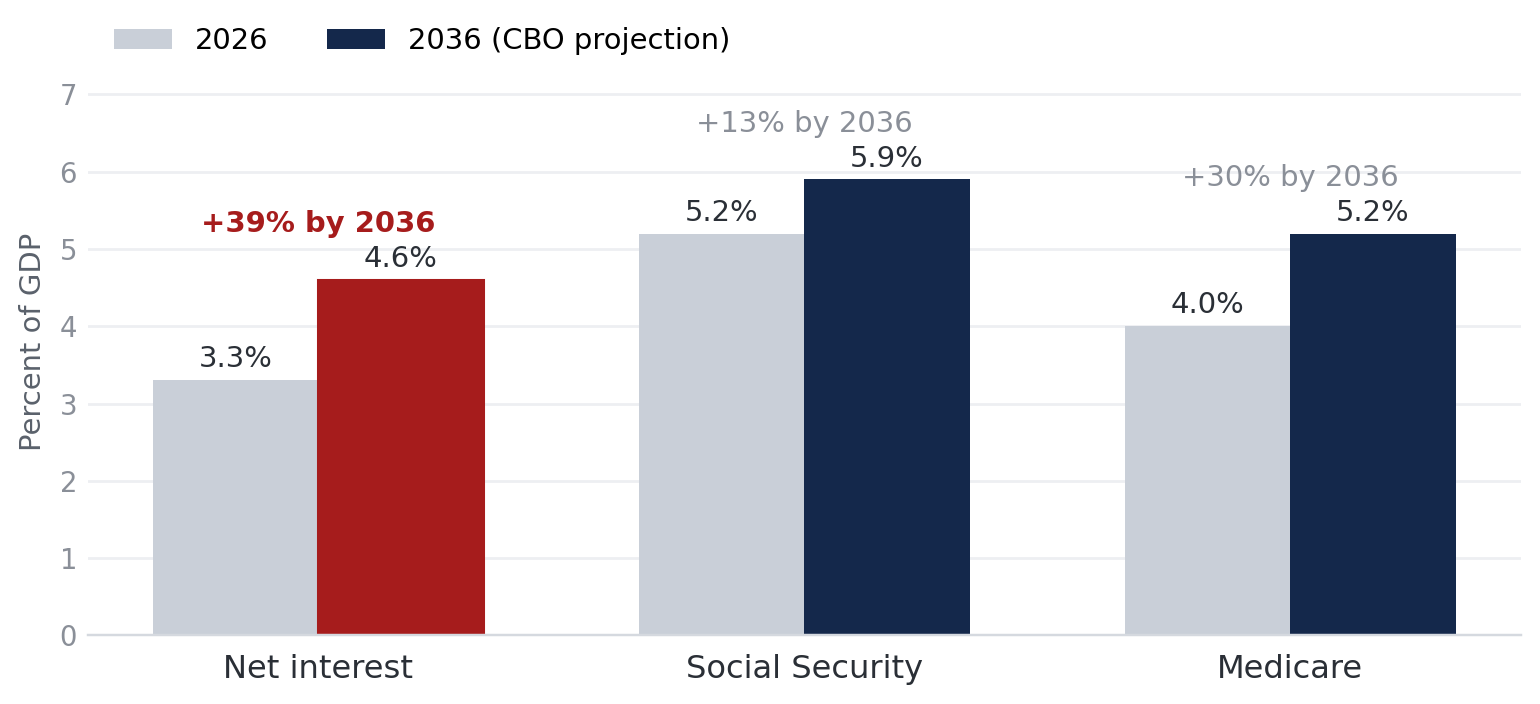
Federal outlays as a percent of GDP, fiscal 2026 versus the 2036 projection. Net interest is projected to rise from 3.3% to 4.6% of GDP — from about $1.0 trillion to about $2.1 trillion — growing faster in relative terms than either Social Security or Medicare. Source: Congressional Budget Office, The Budget and Economic Outlook: 2026–2036 (February 11, 2026). [4] Projections are estimates under current law and may not be realized.
The vigilantes are not necessarily forecasting an American economic crisis. They may instead be demanding a higher price for uncertainty: deficits, enormous future Treasury supply, inflation, trade policy, Federal Reserve independence and the long-term purchasing power of money.
Economist Viktor Shvets has used an intentionally provocative term for this: the “insanity premium.” [2] We prefer to call it an instability premium.
They do not necessarily want to break down the gates. They want to be paid appropriately to stand outside them.
The question is not whether America’s economy or stock market is about to falter. Both could remain remarkably strong. The more useful question is what compensation investors should demand for committing capital for long periods when fiscal uncertainty is increasing – and how capital should be preserved while we wait for opportunities to be properly priced.
That question reinforces our conviction in the Argos Store of Value Protocol.
The bond market is sending a different message
The recent rise in long-term Treasury yields cannot easily be explained by fears of U.S. default or inflation alone. Market-based long-term inflation expectations have remained comparatively contained.
That said, moderating inflation readings are not the entire story. Official measures tell us primarily how quickly prices are changing. They do not fully convey the affordability pressure households can experience after several years of cumulative increases in housing, insurance, food, energy, healthcare and financing costs.
Recent Walmart results provide a useful real-world lens. [6] Consumers continue to shop, but they are increasingly selective and responsive to value. This raises an important question: when inflation readings decline, how much reflects improving supply and productivity – and how much may sometimes reflect demand destruction at the margin as consumers reach the limits of affordability? We do not question the usefulness of official inflation statistics; as risk managers, we simply believe affordability should be monitored alongside inflation.
More broadly, investors appear to be demanding greater compensation for committing capital for decades (read: a higher duration risk premium) amid unusually high government borrowing, geopolitical uncertainty, questions surrounding monetary policy and enormous competing demand for capital from the private sector.
The implication is not necessarily that a crisis is imminent. It means that the price of certainty has gone up.
Different investors, similar concerns
The characterizations below are our summary of these investors’ publicly expressed views, substantiated at sources [5], [7], [10] and [11]. They are not direct quotations, and the common thread we draw from them is our opinion.
Ray Dalio has long argued [7] that persistent deficits eventually confront governments with difficult choices: fiscal restraint, higher borrowing costs, monetary accommodation, or some combination of inflation and currency depreciation.
Warren Buffett has described the fiscal trajectory as unsustainable [5] while remaining emphatically optimistic about America’s long-term productive capacity. Paul Tudor Jones has warned [10] about the interaction between deficits, inflation and bond markets while also recognizing that fiscal stimulus can support economic activity and asset prices for considerably longer than bearish investors might expect. Eric Peters of One River has approached the problem [11] through fiscal dominance and portfolio resilience: prepare for a wider range of monetary outcomes rather than attempt to predict precisely which one will occur.
The common lesson, in our opinion, is not that investors should abandon America. It is that the purchasing power of long-term nominal claims deserves greater scrutiny when debt and interest expense are rising faster than the economy supporting them [1].
Washington is beginning to respond
The administration clearly understands that persistently high long-term yields represent an economic and political problem. Mortgage rates, corporate borrowing costs, government interest expense and ultimately equity valuations are all influenced by the long end of the Treasury curve.
Treasury Secretary Scott Bessent’s response increasingly appears to have two dimensions: manage the mechanics of the bond market today while attempting to improve the fiscal and economic fundamentals that determine yields tomorrow [1].
Treasury recently increased purchases of longer-dated government securities while financing those purchases with greater issuance of shorter-term debt – a maneuver Bessent described [1][3] as a “Treasury twist,” invoking Operation Twist of the 1960s. The objective is to remove some longer-duration securities from the market, improve liquidity and potentially reduce pressure on longer-term yields without changing the government’s overall borrowing requirement.
It worked – briefly. Long-term yields initially fell sharply following the announcement, only to reverse much of the move. The 10-year Treasury ended the week near 4.7%. That reaction contains an important message: Treasury may be able to influence the shape of the yield curve, but it cannot indefinitely determine the price of capital.
Edward Yardeni – the economist who originally coined the term “bond vigilantes” – offers an important counterpoint [12]: perhaps nothing is particularly broken. In his view, rates of 4% to 5% may simply represent a return to historically normal levels after the extraordinarily low-rate world that followed the financial crisis.
Today’s higher yields may reflect not only fiscal anxiety, but also an economy resilient enough to sustain higher rates and an extraordinary global competition for capital. Governments are borrowing heavily while corporations are issuing enormous amounts of debt to finance AI infrastructure, data centers, power generation and related investment.
Bessent has acknowledged this dynamic. The AI investment boom may ultimately increase productivity and create faster, less inflationary economic growth. But before those benefits arrive, hundreds of billions of dollars of investment must be financed. The U.S. Treasury is increasingly competing for capital not simply with other governments, but with some of the world’s most profitable companies. [8]
Exhibit 2 — Treasury is no longer the only borrower at the long end
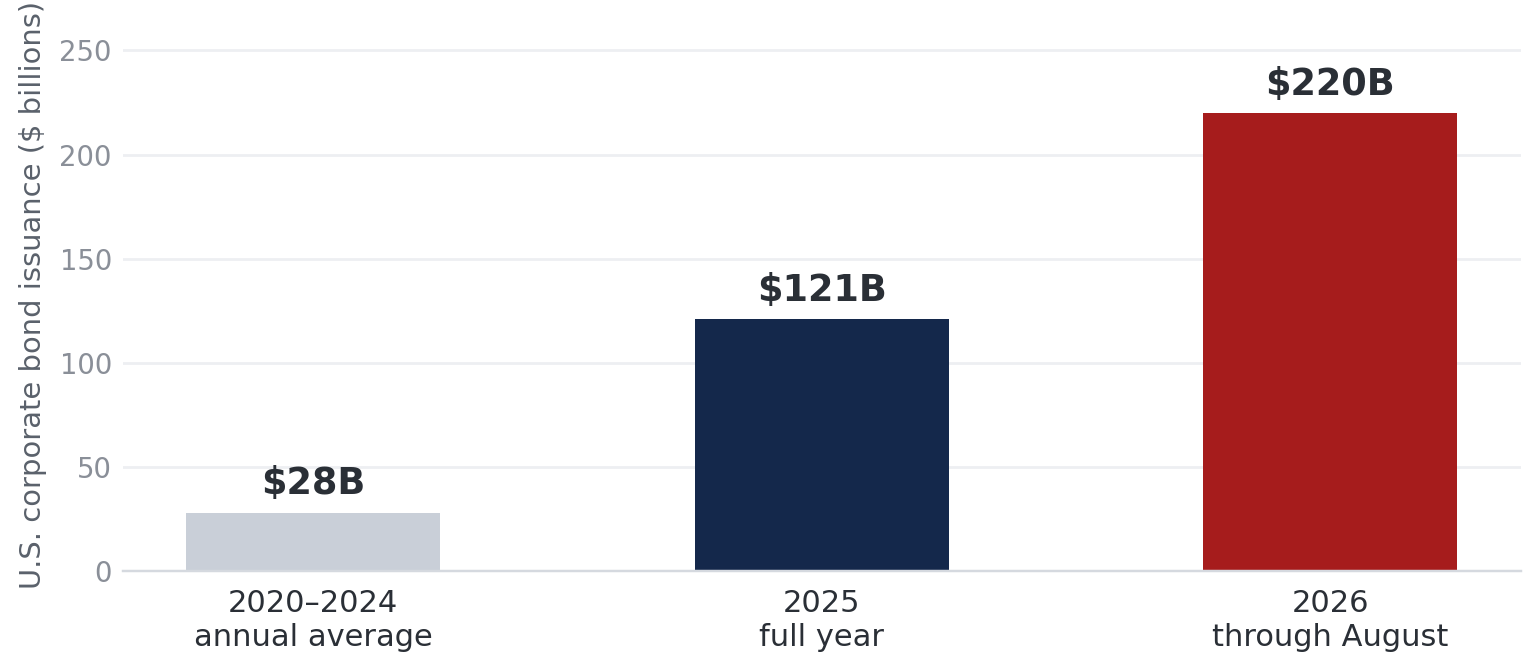
U.S. corporate bond issuance by Alphabet, Amazon, Meta, Microsoft and Oracle. The five companies issued roughly $28 billion a year on average from 2020 through 2024, $121 billion in 2025, and approximately $220 billion in 2026 through August — much of it long-dated, and much of it competing for the same buyers as the Treasury. Source: BofA Securities via Reuters and subsequent market reporting. [8] The 2026 figure is a partial-year total and is not annualized.
The administration’s harder challenge is convincing investors that Treasury interventions are a bridge toward better fiscal fundamentals rather than an attempt to suppress the market’s message. Bessent and Director of the Office of Management and Budget (OMB), Russell Vought, are examining both revenues and expenditures, while the arithmetic remains formidable: interest expense exceeds $1 trillion annually and the structural entitlement burden remains large.
This is why the broader growth strategy matters. Bessent’s original framework [1] sought roughly 3% real growth alongside a deficit eventually approaching 3% of GDP. Deregulation, greater domestic energy production, tax incentives and private capital formation are intended to increase productive capacity – not only restraining the numerator, but growing the denominator.
A credible, independent Federal Reserve can also help reduce the instability premium by anchoring inflation expectations. Yet the emerging contrast between Bessent’s desire for lower long-term yields and Chairman Kevin Warsh’s greater acceptance of market-set rates bears watching, particularly amid discussion of a new Fed-Treasury accord.
The administration can manage the gates. Only credible policy can persuade the vigilantes to move away from them.
There is a constructive path: stronger productivity, greater energy supply, continued private investment, better Treasury-market functioning, anchored inflation expectations and credible progress toward fiscal consolidation. If those pieces come together, today’s instability premium could diminish without requiring either a recession or a major decline in asset prices.
Why the economy may continue to surprise
There are several reasons the economy and equity markets could remain stronger than fiscal pessimists expect.
The AI investment cycle is enormous. Technology companies are deploying extraordinary amounts of capital into semiconductors, data centers, power generation and networking infrastructure. Corporate profitability remains strong. Fiscal policy itself remains supportive of demand, while tax incentives are designed to accelerate private capital formation.
If AI ultimately produces meaningful productivity gains, higher productivity could allow stronger real growth without an equivalent increase in inflation. Higher rates themselves need not bring an expansion to an end: for much of American economic history, 10-year Treasury yields above today’s levels coexisted with strong nominal growth, innovation and rising equity markets.
The administration’s strategy therefore cannot simply be dismissed as an attempt to suppress bond yields. There is a legitimate economic thesis behind it. The question is whether growth and fiscal restraint ultimately arrive in sufficient magnitude to convince the bond market. We do not need to predict the answer.
Why this strengthens our Store of Value conviction
Our Store of Value Protocol is not based on a forecast that the stock market is about to fall. Nor is it a bet against the United States. It is recognition that the range of plausible outcomes has widened.
For capital whose primary purpose is preservation and future deployment, we favor liquidity, quality and limited duration. Very short-term government securities allow investors to earn meaningful income without making a decades-long bet on inflation or interest rates.
And maintaining liquidity creates something whose value is often underestimated: optionality.
Warren Buffett provides perhaps the best example. As Berkshire Hathaway’s own SEC filings show, the company has repeatedly accumulated extraordinary reserves of cash and short-term Treasury bills while simultaneously owning hundreds of billions of dollars of productive businesses and equities. Those positions are not contradictory.
Buffett does not accumulate liquidity because productive assets are inherently undesirable. He accumulates liquidity because capital need not be deployed simply because it is available. That distinction is fundamental to our philosophy.
Our Store of Value Protocol is not intended to be a permanent destination for capital. We approach it with an opportunistic mindset. It is a reservoir of purchasing power from which we should be prepared to deploy capital when the relationship between price, value and risk becomes sufficiently compelling.
If equity valuations improve materially, we want the ability to buy productive businesses. If credit markets offer unusually attractive compensation for taking risk, we want capital available. If other investments develop compelling asymmetries between potential return and downside, we want the flexibility to pursue them.
The purpose of Store of Value is therefore not simply to preserve. It is to preserve the ability to act.
Prepared, not positioned for a prediction
We remain constructive on America’s capacity for innovation, productivity and wealth creation. We also believe that a $40 trillion federal debt burden, structural deficits and rising interest expense deserve respect.
The mistake would be believing that investors must choose one narrative.
The economy can remain strong while fiscal risk increases. Equities can continue appreciating while long-term bonds demand greater compensation. AI can generate tremendous economic value while simultaneously creating extraordinary competition for capital. Inflation can moderate while households still experience significant affordability pressure. And an administration can pursue pro-growth policies while eventually being forced to demonstrate greater fiscal discipline.
Our job is not to predict exactly when those forces converge. It is to construct portfolios capable of prospering while they do.
Sincerely,
Argos Wealth Advisors
Sources
[1] Scott Bessent, “Remarks by Secretary of the Treasury Scott Bessent before the Treasury Market Conference,” U.S. Department of the Treasury, November 12, 2025, U.S. Treasury transcript; Scott Bessent, interview by Sara Eisen, Squawk on the Street, CNBC, August 20, 2026, CNBC transcript. Bessent has described the Treasury secretary as the “primary caretaker of the Treasury market” and emphasized gradual adjustments to issuance, market liquidity, investor demand, and borrowing costs, while linking the longer-term path of yields to deficit reduction, productivity, investment, and economic growth.
[2] John Authers, “Bessent Must Envy When the Grownups Were in Charge,” Bloomberg Opinion, Aug. 21, 2026. Article text supplied by the client. https://www.bloomberg.com/opinion/articles/2026-08-21/bessent-must-envy-when-the-grownups-were-in-charge
[3] Reporting on the expansion of Treasury buybacks and the “Treasury twist,” August 19-20, 2026: CNBC and Bloomberg (Chris Anstey, “A ‘Bond Vigilant’ Bessent Moves to Head Off the Bond Vigilantes,” Bloomberg, August 20, 2026, https://www.bloomberg.com/news/newsletters/2026-08-20/a-bond-vigilant-bessent-moves-to-head-off-the-bond-vigilantes).
[4] Congressional Budget Office, The Budget and Economic Outlook: 2026-2036. https://www.cbo.gov/publication/61882
[5] Warren E. Buffett, Berkshire Hathaway Inc., 2024 Letter to Shareholders (https://www.berkshirehathaway.com/letters/2024ltr.pdf), in which Mr. Buffett writes that paper money can lose its value “if fiscal folly prevails” while restating his reliance on American businesses; and Berkshire Hathaway Inc. SEC filings, 2025-2026, for the company’s reported cash and short-term U.S. Treasury holdings. The 2025 shareholder letter was authored by Greg Abel and is not the source for either point.
[6] Reuters, Walmart reports rare comparable-sales miss as consumers pare back spending, Aug. 20, 2026. Reuters wire story, syndicated copy: https://www.investing.com/news/stock-market-news/walmart-reports-rare-comparable-sales-miss-as-consumers-pare-back-spending-4869318
[7] Ray Dalio, How Countries Go Broke: Principles for Navigating the Big Debt Cycle (Avid Reader Press, June 2025), and Mr. Dalio’s public discussion of the book, including Bloomberg’s Odd Lots podcast (2025) and PBS, “Ray Dalio: U.S. Will ‘Hit the Rocks’ Without Bipartisan Debt Fix,” June 6, 2025.
[8] BofA Securities (January 2026) via Reuters, and subsequent market reporting, on U.S. corporate bond issuance by Alphabet, Amazon, Meta, Microsoft and Oracle, 2020–2026. Used for Exhibit 2.
[9] Argos internal market reference set, as of 2026-08-25 (30-year and 10-year U.S. Treasury yields).
[10] Paul Tudor Jones, interview with Andrew Ross Sorkin, CNBC, October 22, 2024 (https://www.cnbc.com/2024/10/22/paul-tudor-jones-says-market-reckoning-coming-after-election-on-spending-we-are-going-to-be-broke.html), and interview on the Invest Like the Best podcast, April 2026.
[11] Eric Peters, One River Asset Management: MacroVoices episode 187, “The Era of Monetary Dominance will give way to Fiscal Dominance” (https://www.macrovoices.com/713-macrovoices-187-eric-peters-the-era-of-monetary-dominance-will-give-way-to-fiscal-dominance), and his “Wknd Notes” letter, https://www.oneriveram.com.
[12] Edward Yardeni: “Bond Investors Are the Economy’s Bond Vigilantes” (July 1983), and his August 2026 commentary on the 4%-5% range for the 10-year Treasury yield, reported by CNBC, August 18, 2026 (https://www.cnbc.com/2026/08/18/ed-yardeni-on-when-it-will-be-time-to-worry-about-the-bond-vigilantes.html).
Important Disclosures
Argos Wealth Advisors, LLC is an SEC-registered investment adviser; registration does not imply a certain level of skill or training. This commentary is for informational purposes only, reflects opinions as of the date of publication, and is not investment, legal, or tax advice, nor an offer or solicitation to buy or sell any security. Nothing herein is a recommendation to buy, sell or hold any security or to adopt any investment strategy. All investing involves risk, including the possible loss of principal; past performance is not indicative of future results, and no assurance can be given that any investment objective will be achieved. Statements regarding future economic, fiscal or market conditions are forward-looking, are based on assumptions that may prove incorrect, and are subject to change without notice; actual results may differ materially. Yields, index levels and other market figures are sourced from public market data and third-party sources believed to be reliable but not independently verified, and are provided for context only. Indices are unmanaged, do not reflect the deduction of advisory fees, expenses or transaction costs, may not reflect the risk profile of any Argos portfolio, and it is not possible to invest directly in an index. References to third parties are for illustration only and do not imply any endorsement of, or affiliation with, Argos. Advisory fees and underlying fund expenses reduce returns over time. See our Form ADV Part 2A for additional information about our advisory services, fees, and conflicts of interest.
